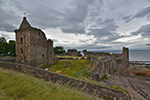
Broughty Castle
History
In 1454 the 4th Earl of Angus received permission to build a castle in this location. In 1489, English ships were captured nearby, which prompted the need for more defenses along the Tay, and in 1490, King James IV granted the site to Andrew, 2nd Lord Gray. Gray built the rectangular tower house, with four main storeys and a garret set back behind a wall-head parapet, and it was probably finished in 1496, the date inscribed on its walls. It formed the core of the castle overlooking the mouth of the River Tay.

After the Battle of Pinkie in 1547, during the Rough Wooing, Patrick, 4th Lord Gray, handed Broughty Castle to the English without a fight. From Broughty, the English harried Dundee for two and a half years until the castle was taken back by the Scots, with help from the French, on February 12th, 1550, and was partially demolished.

The tower house on the shore of the Firth of Tay.
Although partially demolished, the castle was held for Mary, Queen of Scots, by the Duke of Chatelherault until 1571. In 1651 during the Wars of the Three Kingdoms, the castle was taken for Oliver Cromwell by General Monck, and Alexander Leslie, Earl of Leven, was imprisoned within the castle. When the Gray family sold the castle in 1666, it gradually became more ruinous.
By 1821, Broughty Castle was a roofless ruin. In 1846, the Edinburgh and Northern Railway company acquired it and built the adjacent harbor for its railway ferry. In 1855, at the end of the Crimean War, the War Office bought it with the idea of defending the mouth of the Tay from the Russians, though nothing was done then. In 1860 and 1861, because of a feared French invasion, the ruin was rebuilt as an artillery fort, enlarged and given gun emplacements for nine large guns, but no attack occurred. The defenses were strengthened on a number of occasions, and further alterations were made during the First and Second World Wars, resulting in stronger defenses and a defense post constructed at the top of the tower in 1942. The military continued to use the castle until the middle of the 20th century, and in 1969, it became a museum. In March 2026, £150,000 of joint investment from Dundee City Council and the Northwood Charitable Trust secured the museum's future for three years, after it had been threatened with closure.
Castle Highlights

Cannons on the Victorian gun battery.
Broughty Castle sits proudly at the mouth of the River Tay, and visitors can climb the central Tower House and explore the inner ward.
The museum inside the tower is free and self-guided. The Broughty Life Gallery follows a fictional “Brochtie” family from prehistoric times to the present, showing how food, shelter, work, and recreation have changed. The Orchar Collection shows part of the collection of James Guthrie Orchar, more than 400 works and one of the most important collections of Victorian Scottish art in the country. Broughty Life On Land explores the geology and natural history of the Broughty Ferry Local Nature Reserve, and the Armoury Gallery tells how the castle helped defend the coast in the two world wars, along with the history of the local volunteer forces. At the top, the Observation Deck looks out over the Tay estuary, and binoculars are available from reception for a small deposit, so you can watch for Atlantic bottlenose dolphins in the water below.
The outer ramparts surrounding the courtyard and some cannons still exist in addition to the Tower House. Broughty Castle can be thoroughly explored in a few hours. To make a full day of visiting castles, Claypotts Castle is just a few miles north, on Dundee's edge.