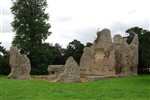
Baconsthorpe Castle
History
Baconsthorpe Castle was built in the 15th century by successive generations of the prominent Norfolk family, the Heydons. William Heydon acquired the site from the Bacon family in the early 15th century. English Heritage records him as William Baxter, a free yeoman, and says his son John changed the family name to Heydon to disguise his humble origins. A lawyer and agent of the Duke of Suffolk, John grew in social and political prominence during the Wars of the Roses, when he often switched sides to suit himself, and he probably began building at Baconsthorpe in about 1450, starting with the great inner gatehouse. He died in 1479.

John's son, Sir Henry, who was knighted at the coronation of Henry VII in 1485, completed the moat and the fortified house in the southwest corner later in the 15th century and added the garden court in the early 16th century. His son, Sir John Heydon II, converted the eastern service range into a wool-processing factory. Around 1560, Sir Christopher Heydon added the outer gatehouse and outer court, and in 1561, he laid out a park. He was said to have hosted 30 head shepherds at Christmas, which suggests that he had 20,000 to 30,000 sheep on his lands. Despite being a successful businessman, Sir Christopher died in debt, causing his son William to sell off part of Baconsthorpe.

The moat and mere beside the castle.
At the turn of the 17th century, the ornamental mere was created on the east arm of the moat. The formal gardens recorded as being to the east were also probably made at this time. The family fortunes were in decline by the mid-17th century, which led to the demolition of most of the castle in 1650 except the outer gatehouse, which survived and was converted into a house known as Baconsthorpe Hall, which remained inhabited until 1920 when one of the turrets collapsed. The stained glass Heydon shields were removed from the banqueting hall and added to the windows of the south aisle of Baconsthorpe Church.
The demolition was carried out by Sir John Heydon III, who had supported Charles I in the Civil War, and in 1654, his son sold 29 cartloads of the stone, which were reused at Felbrigg Hall. The castle was placed in the care of the Ministry of Public Works in 1940, and after the ivy was cleared and the stonework repaired, it opened to the public. The mere was dredged and refilled in 1972, and the castle is now managed by English Heritage. Repairs to the gatehouses, the north-east tower, and the moat bridge closed the castle from 2024 until it reopened after the conservation work.
Castle Highlights
Baconsthorpe Castle is a peaceful ruin nestled in remote farmlands off the beaten track. The water-filled moat remains and enough curtain wall to quickly identify the castle's layout.

The outer gatehouse.
One of the most prominent parts of the castle today is the outer gatehouse which is finished in dressed flint. Only its east turret survives, an octagonal turret topped with an ogee-shaped cupola. The outer gatehouse was the only part of the castle for which the license to crenelate was obtained in 1561, yet it is entirely void of defensive features. Behind the outer gatehouse and across the outer court are the remains of the massive three-story inner gatehouse. Although it is a formidable structure, it was built more for comfort than defense, as it has large windows and no gun loops of its own, although the curtain wall beside it has six double embrasures and one tower has a small gun port. The gate passage is vaulted, with a groin-vaulted chamber on each side, one probably the porter's lodge, and a stair turret leads up to apartments on the floors above.

The inner gatehouse.
The inner court was enclosed by a curtain wall with seven towers, and the three-story north-east tower was later used for wool processing. A long building in the inner court was a wool-processing range, and the service court in the northeast corner had kitchens and a well. A modern timber bridge now crosses the moat to the inner gatehouse, resting on the massive flint and brick pier that once carried the drawbridge.

The well in the service court.
Baconsthorpe Castle is open to the public and free to visit. It is a nice place for a picnic; exploring should take at least an hour or two. To make a full day, Castle Acre is only 30 miles from Baconsthorpe.
Baconsthorpe Castle is also haunted.