Château de Chaumont
History
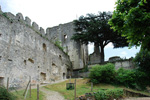
The Château de Chaumont rises above the Loire on "Bald Hill", or Chauve Mont. Built around 1000 by Odo I, Count of Blois, it defended his lands from rival Fulk Nerra, Count of Anjou.

It passed through various owners, including the Norman knight Gelduin, eventually becoming the possession of the d'Amboise family via marriage in 1054, who held the castle for almost five centuries.
In 1465, Pierre d'Amboise joined the League of Public Weal against King Louis XI, but the League failed, and the castle was burned and razed by royal order. In 1469, Louis XI allowed rebuilding, begun by Charles d'Amboise. Only the North and West Wings were finished by his death in 1481.
After Charles's death, his son, Charles II d'Amboise, continued work on the castle from 1498 to 1511, supported by his uncle, Cardinal Georges d'Amboise. During this period, they added early Italian Renaissance features but kept a medieval look. The result was a quadrangular castle with corner towers and surrounding ditches.
In 1550, the castle was purchased by Catherine de' Medici, who used it as a hunting lodge and a place to stop between Amboise and Blois. She entertained numerous astrologers at the castle, including Nostradamus. When her husband, King Henry II, died in 1559, Catherine forced his mistress, Diane de Poitiers, to exchange Château de Chenonceau for Chaumont. Diane lived at Chaumont briefly before moving elsewhere, but did complete the upper parts of the East Wing and the Barbican.
In 1594, Diane's granddaughter Charlotte de la Marck died. As a result, Chaumont passed to her husband, Henri de La Tour d'Auvergne, Duke of Bouillon, who subsequently sold it to Largentier, a wealthy salt tax collector.
Next, the Lucca family owned it until 1667, when the seigneurs de Ruffignac took possession.
In 1699, Paul de Beauvilliers, duc de Beauvilliers, bought Chaumont. He modernized some interiors with enough grandeur to house the duc d'Anjou, who was en route to becoming King of Spain in 1700. In 1739, the North Wing of the castle was demolished to open views of the River Loire.
In 1750, Jacques-Donatien Le Ray bought Chaumont and established tile, pottery, and crystal works. He supported American independence and befriended Benjamin Franklin, who visited the castle. Chaumont also survived the French Revolution unscathed.
In 1875, Marie-Charlotte-Constance Say purchased Chaumont. With her husband, Prince Henri-Amédée de Broglie, she restored and modernized the castle, added stables in 1877, and created formal gardens in 1884. The estate gained fame for high-society events. In 1938, she donated Chaumont to the government.
Today, Château de Chaumont is a museum and popular tourist site that hosts an annual Garden Festival.
Castle Highlights
Château de Chaumont is one of the top castles to visit on the River Loire. The castle welcomes visitors year-round, allowing you to explore at your own pace. It is best to set aside several hours to fully enjoy the site.
The grounds feature formal gardens, and the stables are highlights worth visiting. There are two stables: the larger Great Stable for the owners and a second for guests. The Great Stable showcases the Gala Saddlery, considered exceptional. When visiting the stable area, look for the horse-drawn carriages on display.
Inside are "Historical Rooms" with objects from the 15th to 19th centuries. The Ruggieri Room honors astrologer Ruggiero il Vecchio, who served Catherine de Medici. Catherine's room features the castle's oldest tapestry, from the 15th century, depicting Perseus and Pegasus. The Guard Room was both a secure entrance and a training area; guards watched the drawbridge and courtyard from its windows.
The Private Apartments in the South and West Wings were remodeled in 1877. They include the Dining Room, Library, Small Salon, Great Salon, and Billiards Room. There is also a chapel with a stained-glass window that dates from 1888.
A visit to Château de Chaumont typically takes at least half a day. Combine your visit with a trip to the nearby Château de Montrichard for a full day of sightseeing. Chambord and Chenonceau are in the same region, but each requires at least half a day to explore properly, so plan to spend a few days to avoid a rushed experience.