Schloss Oberstein
History
Schloss Oberstein was built around 1320 by the Lords of Daun-Oberstein as "the new house" above Burg Bosselstein. Around 1075, the Lords of Stein lived in the castle in the Loch, a unique cave castle halfway up the hillside to Burgh Bosselstein. In 1190, the family split into two branches, the Eberhard line and the Bossel line.

The Bossel line regarded the Oberstein Lordship as a power base and built and lived at Burg Bosselstein, above the cave castle. Around 1250, the von Daun family married into the Bossel line when Gud von Oberstein married Wirich von Daun, forming the powerful Daun-Oberstein family.
The Daun-Obersteins were not only entitled to the Bossel family land rights in the area, but they also lived with them at Burg Bosselstein.
Ownership was disputed between the Lords of Oberstein and the Lords of Daun-Oberstein over Burg Bosselstein, which led to the construction of Schloss Oberstein, on the opposite hill, by the Daun-Oberstein's around 1320, while the Lords of Oberstein remained at Burg Bosselstein.
Although the construction of Schloss Oberstein helped calm disputes among the family branches, it took another half-century for the rule of the Daun-Obersteiners to be consolidated.
Schloss Oberstein passed by inheritance to the Daun-Falkenstein line and served as the main residence of the Counts of Daun-Oberstein-Falkenstein until 1624, when it became their administrative seat.
After 1636, Philipp Franz was likely the last Daun-Obersteiner to live permanently at the castle. After his death, the castle was administered by officials. Philipp Franz was buried in the Felsenkirche. His son died earlier, during the Thirty Years' War, so the castle fell to Wilhelm Wirich from the Broich line.
Wilhelm's only son died in a duel, and in 1667, Wilhelm Wirich von Daun-Falkenstein sold the impoverished county of Falkenstein to Duke Charles IV of Lorraine. When Wilhelm died in 1682, the Daun-Falkenstein line became extinct, and Schloss Oberstein remained the seat of a bailiff under various successors.
During the War of Reunions (1683-1684), Schloss Oberstein was occupied by the troops of Louis XIV of France until 1697, when the Treaty of Rijswijk was signed. In 1697, the four corner towers of the castle were destroyed by French troops during the War of Palatine Succession, or the Nine Years' War.
Napoleon Bonaparte's revolutionary troops occupied the left bank of the River Rhine and auctioned off the castle to families from Oberstein, who lived there until it sustained further damage in a 1855 fire.
Since 1981, Burg Oberstein has been undergoing constant restoration, led by the Burgenverein Schloss Oberstein, a nonprofit dedicated to preservation and cultural promotion.
Castle Highlights
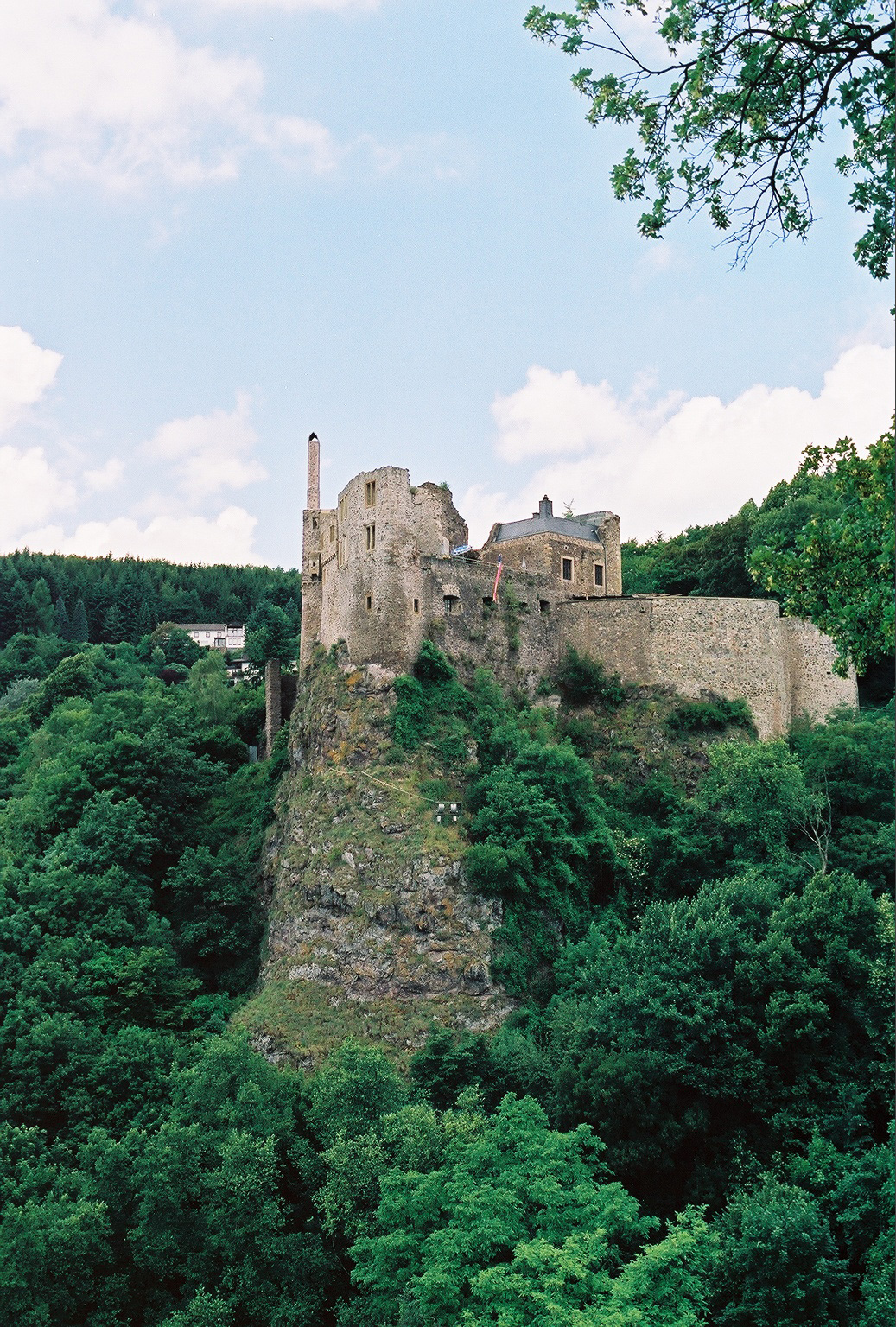
Schloss Oberstein is perched high on a hilltop overlooking the Nahe Valley, surrounded by the forests of the Winterhauch. There is a parking garage in the town, Idar-Oberstein, below the castle. It's about a 30-minute walk from town up to the castle, but you can stop for a rest along the way by visiting the Felsenkirche, the Crag Church embedded in the side of the mountain.
The castle originally consisted of four corner towers and a triangular central complex of buildings. The gatehouse to the castle features a Gothic Bay window, atypical for castles in the region. From the castle, visitors can enjoy panoramic views of the town and Burg Bosselstein.
The Coat of Arms stone above the entrance door to the hall shows eight coats of arms of Wirich IV's great-grandparents, dating from around 1475, which he used to document his noble origins. The round Stair Tower, probably dating from the 15th century, leads to the south-east wing, rebuilt in 1650.
Castle can be rented for occupancy or to host events or weddings. You can also arrange for a private guided tour of the castle by appointment.
Nearby Burg Bosselstein is more ruinous, located along a footpath on the adjacent hill, and is worth a visit while you are visiting Schloss Oberstein. Both castles offer the best views of the other.
Photographs of Schloss Oberstein courtesy of Cheryl Cavett.