Oakham Castle
History
Oakham was an important royal manor in Anglo-Saxon times, and there was probably a royal hall on this site well before the Norman Conquest. The Domesday Book of 1086 records a hall at Oakham. The first castle was a motte and bailey built of wood and earth, and nothing of it remains apart from the motte in the south-east corner, which was later incorporated into the ramparts and castle walls.
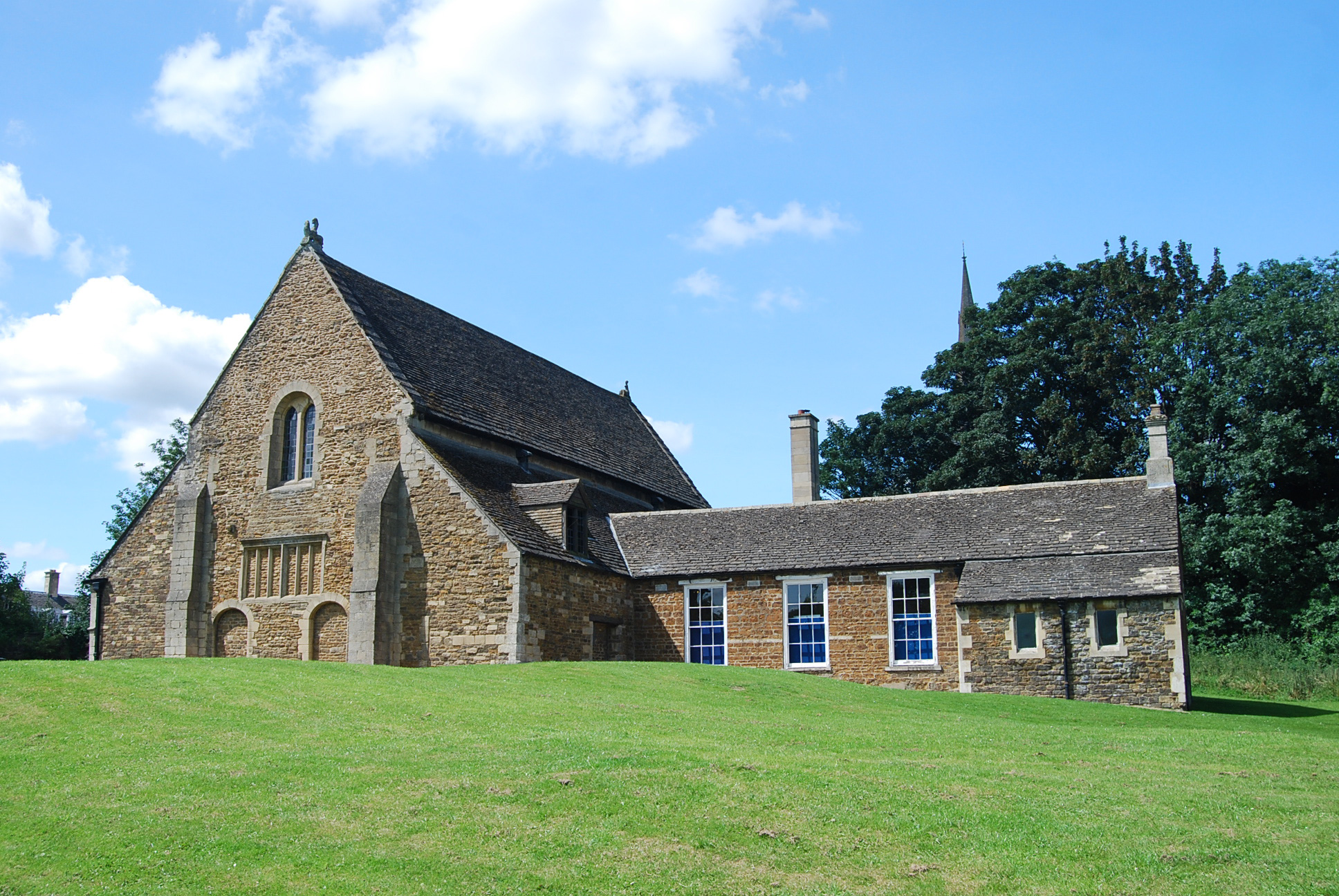
Walkelin de Ferrers, the Norman baron who held the manor, built the stone Great Hall between 1180 and 1190, and it survives today. The great hall is constructed of ironstone rubble with ashlar dressings and maintains its medieval charm despite minor repairs through the centuries.

The earthworks of the castle.
During the medieval period, Oakham Castle was an administrative, legal, and manorial center rather than a defensive stronghold. In the 13th century, it was fortified with a stone curtain wall against the existing earthworks, a gatehouse, a moat, and a drawbridge with iron chains. A description written in 1340 lists a hall, a chapel, a kitchen, two stables, a barn, a house for prisoners, a county gaol, and a room for the gatekeeper. The royal gaol for Rutland was within the grounds until the 15th century.
Oakham Castle is one of the longest-running seats of justice in England, with the first assize recorded in 1229, and a Crown Court still sits there every two years. In 1264, the great hall was damaged by fire during the Barons' War, and in 1272, the castle returned to the king.

The Norman doorway of the Great Hall.
An inquisition in 1521 found the hall in good repair and still used for courts, while the rest of the castle was ruinous. In 1621, George Villiers, Duke of Buckingham, leveled the surrounding ruins and re-roofed the hall. From 1888 until 1936, it was the meeting place of Rutland County Council, which owns it today. The council restored the great hall, its horseshoes, and the curtain wall in 2014 and 2015 with a Heritage Lottery Fund grant of about 2.1 million pounds, and the castle reopened on May 30th, 2016.
Castle Highlights
Originally a motte and bailey castle, not much remains of the outer defenses of Oakham Castle other than earthworks that provide some sense of the external shape and size of the castle. However, the great hall remains intact and is one of Europe's finest examples of 12th century Norman domestic architecture.

The horseshoes on the walls of the Great Hall.
The great hall is most famous for the collection of about 230 horseshoes it proudly displays on the hall's walls. By tradition, peers of the realm and royalty present a horseshoe to the Lord of the Manor on their first visit to Oakham. The oldest surviving horseshoe dates back to Edward IV's visit in 1470 after his victory at the Battle of Losecoat Field, and recent donors include the Princess Royal in 1999, the Prince of Wales in 2003, Princess Alexandra in 2005, the Duchess of Cornwall in 2014, and the Duke and Duchess of Edinburgh in 2024. The castle can be used for civil marriages. The great hall has a nave with two arcaded aisles and several small sculptures, including six musicians, presumably carved by the same masons that built Canterbury Cathedral.
Oakham Castle can be thoroughly visited in an hour or two. If you wish to see another castle the same day, Rockingham Castle is less than 15 miles from Oakham Castle.