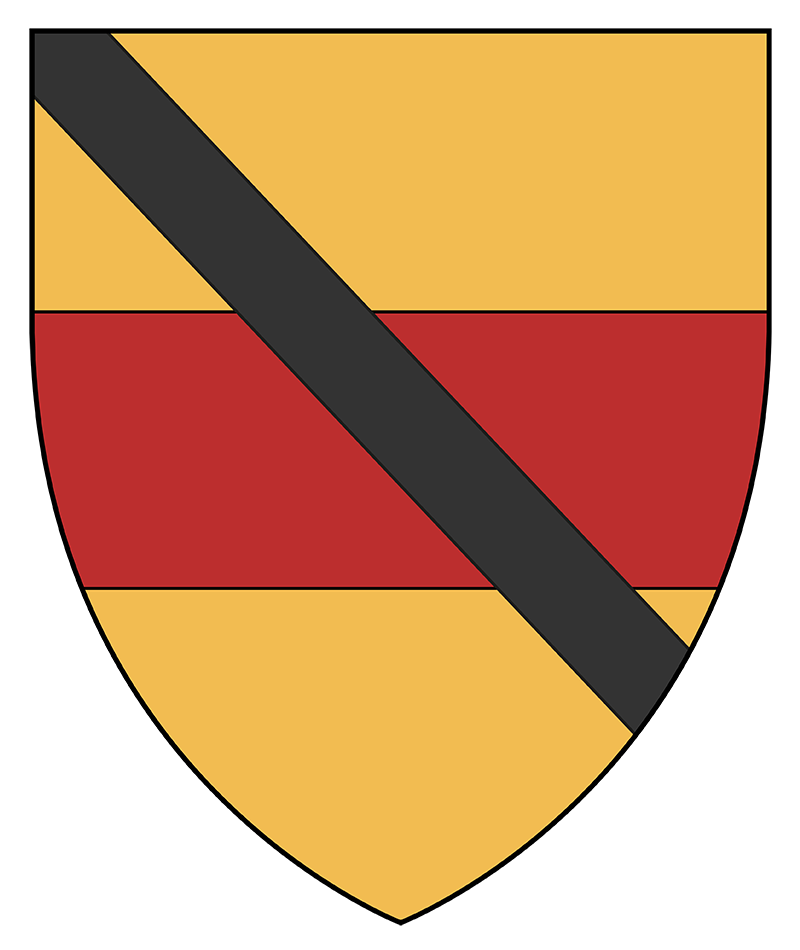
Hugh de Lacy - Lord of Meath
4th Baron de Lacy
Hugh de Lacy was a powerful Anglo-Norman Nobleman, landowner, and royal administrator who played a significant role in the Norman conquest and settlement of Ireland. As a key architect of the Anglo-Norman presence there, he transformed Meath with strong fortifications, most notably Trim Castle, which symbolized his authority.

Born around 1135 in Herefordshire, England, Hugh de Lacy was the son of Gilbert de Lacy of Ewyas Lacy, Weobley, and Ludlow, and Agnes de Lacy. The family originated from Lassy, Normandy. Hugh inherited the family holdings when his elder brother died without heirs.
By 1155, Hugh had married Rohese of Monmouth, granddaughter of Gilbert FitzRichard, who was also the grandfather of Richard de Clare (Strongbow). Hugh and Rohese had at least eight children: Walter, Hugh, Gilbert, Robert, Elyane, Alice, Egidia, and another daughter whose name is unknown.
In October 1171, Hugh accompanied Henry II as part of the Anglo-Norman force invading Ireland. He returned in early 1172 to accept Rory, High King of Ireland's submission on Henry's behalf. Before leaving for England, Hugh was granted the Kingdom of Meath for the service of fifty knights, nearly with royal authority, and was also made custodian of Dublin Castle and justiciar of Ireland.
Hugh needed to conquer and stabilize Meath, facing resistance from Irish lords such as Tigernán Ua Ruairc, King of Bréifne. Ua Ruairc, ruler of Meath at the time, parleyed with Hugh on the Hill of Ward. Negotiations broke down, leading to a dispute in which an interpreter was killed by a blow that was intended for de Lacy. Ua Ruairc was then killed while mounting his horse by a spearman and decapitated, enabling the Anglo-Normans to consolidate control. His head was displayed over Dublin Castle's gate before being sent to Henry II.
Hugh left Richard de Clare in charge of Dublin, as ordered by the King, and began fortifying his authority by building castles, including the massive stone keep at Trim Castle, one of Ireland's largest Norman castles.
Hugh soon returned to England and was sent to Canterbury on December 29, 1172, where Giraldus notes he reproved Archbishop Richard of Dover. The next year, Hugh fought for King Henry in France, holding Verneuil-sur-Avre against King Louis VII for a month until its surrender.
In 1177, Hugh was appointed Justiciar of Ireland after Richard de Clare's death. His grant of Meath was confirmed, with the addition of the territories of Kildare, Offaly, and Wicklow. As governor, Hugh secured Leinster and Meath by building castles, while allowing Irish lords to retain their lands.
Rohese, Hugh's first wife, died before 1180. He remarried, this time to Róis Ní Chonchobair, daughter of King Ruaidri Ua Conchobair of Ireland. Hugh and Róis had two children: William Gorm de Lacy and Ysota de Lacy.
In 1181, Hugh was recalled from Ireland for marrying Róis without King Henry's approval, but returned the next winter with a co-adjutor, Robert of Shrewsbury.
In 1185, King Henry II sent his son, John Lackland, future King John I, to Ireland, where he reported that Hugh de Lacy would not allow the Irish to pay tribute, which caused friction between de Lacy and the King. Despite this, de Lacy remained in Ireland and continued building castles.
On July 25, 1186, while supervising construction of the motte-and-bailey castle at Durrow in Leinster, Hugh de Lacy was killed by Gilla-Gan-Mathiar O'Maidhaigh, an Irish laborer, who struck off his head with an axe with a single blow, in protest of the demolition of an ancient monastery. Prince John promptly returned to Ireland to claim de Lacy's lands.
Hugh de Lacy was buried at Durrow Abbey. However, in 1195, his body was moved by the Archbishops of Cashel and Dublin to Bective Abbey in Meath, while his head went to St Thomas's Abbey in Dublin. A dispute over his remains between the two abbeys followed. In 1205, his body was reburied with his head in St Thomas's Abbey beside his first wife, Rohese. His son Walter de Lacy succeeded him as Lord of Meath.