Invergarry Castle
History
Invergarry Castle overlooks Loch Oich in the Great Glen and was the seat of the Chiefs of the Clan MacDonell of Glengarry, a powerful branch of the Clan Donald. It stands on Creagan an Fhithich, or "the Raven's Rock," which was also the clan's slogan.

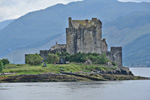
There were at least two castles where Invergarry Castle now sits on Creagan an Fhithich before the current castle. The MacDonells built a castle after raids by the Clan Mackenzie in 1602, which included the burning of Strome Castle. The present castle, a five-story L-plan Tower House with a six-story round tower, was completed after about 1670 and by 1691.

The castle seen between the trees.
The MacDonells supported the royalist cause, and in 1645, Glengarry was raided by the Covenanters, and in 1646, the Marquis of Montrose visited the castle. In 1654, Oliver Cromwell's troops under General Monck, 1st Duke of Albemarle, burned the castle. The castle was rebuilt after that, and a building agreement dates to 1670. In 1688, Alastair MacDonald of Glengarry fortified it for King James VII of Scotland, and he held it until it surrendered to the forces of William and Mary in 1692.
The castle has a grisly link to the Keppoch murders. On September 25th, 1663, Alexander MacDonald, the young chief of the MacDonalds of Keppoch, and his brother Ranald were stabbed to death by their cousins, Alexander MacDonald of Inverlair and his six sons. Justice was slow, but the Gaelic bard Iain Lom, a kinsman of the victims, pressed for action, and in 1665, a commission of "fire and sword" was obtained from the Privy Council. Iain Lom and his men tracked down the seven killers at Inverlair, killed them, and cut off their heads. The heads were washed at a well beside Loch Oich and presented at Invergarry Castle to Glengarry, who had not acted before, and they were later sent to Edinburgh for public display.
The Jacobites held the castle during the 1715 uprising, when Alasdair Dubh of Glengarry retook it and fought at Sheriffmuir, but it was taken for the government in 1716. By 1731, the MacDonells were back in possession. During the 1745 uprising, the Jacobites held it again, and it was visited twice by Charles Edward Stuart, Bonnie Prince Charlie. His first visit was shortly after raising the Royal Standard at Glenfinnan. He is said to have rested at Invergarry Castle after his defeat at the Battle of Culloden in 1746.

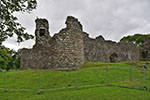
The broken wall of the round tower.
In the aftermath of Culloden, the castle was sacked and partially burned by troops under the “Butcher” Duke of Cumberland as part of his suppression of the Highlands. The south-east wall was removed and the north-west extension of the "L" was demolished. The castle was never rebuilt and abandoned in favor of a new Invergarry House. Alasdair Ranaldson MacDonell, who was chief at the turn of the 19th century, was painted by Sir Henry Raeburn, and he is said to have been the model for Sir Walter Scott's Fergus MacIvor in Waverley. In 1812, he erected the Well of the Seven Heads monument beside Loch Oich, a short distance from the castle, to commemorate the revenge described above, although its inscription gets some details wrong. The Glengarry estate was sold in 1838, and by 1860, Edward "Bear" Ellice, a director of the Hudson's Bay Company, had added the Glengarry lands to his estate. The architect David Bryce built a new Invergarry House for his son between 1866 and 1869, and it is now the Glengarry Castle Hotel.
In 1960, Invergarry Castle, the Well of Heads, and the burial ground were transferred to the Invergarry Castle Preservation Trust. Around 2000, the remaining north staircase collapsed, leading to a 2007 consolidation program under the direction of Historic Scotland, including inserting stabilizing beams into the interior. The ruin is a scheduled monument.
Castle Highlights
The grounds in front of Invergarry Castle can be visited free of charge. Still, the interior is off-limits to everyone because it is unstable and too dangerous to enter, and the ruin is fenced off. Enough remains of the ruined castle walls to warrant a quick stop to view if you are traveling along the Great Glen. You can park on the grassy areas in front of the castle, as there is no paved car park.

The castle from the front.
The castle consists of a five-story L-plan Tower House block and a six-story round tower with a spiral staircase. The ground floor has gunloops built into the walls, and the castle walls are still pierced with shotholes from the English Civil War.
As did the round stair tower, a stair tower at the re-entrant angle also reached the upper floors. There was a great hall on the first floor, which measured 44 by 20 feet.
The ruins of Invergarry Castle will take less than an hour to view from the outside. To see more castles, Inverlochy Castle is located south near Fort William, and Eilean Donan Castle is a bit further west near Kyle of Lochalsh.