Battle of Glen Trool
Background
After their victory at the Battle of Turnberry, Robert the Bruce and his army established a foothold back in Scotland in February of 1307.
To gain more support, he raided an English camp at Clatteringshaws Loch, alerting the English to his location. Aymer de Valence, who had defeated Robert at Methven, learned that Robert was camped at Glen Trool.
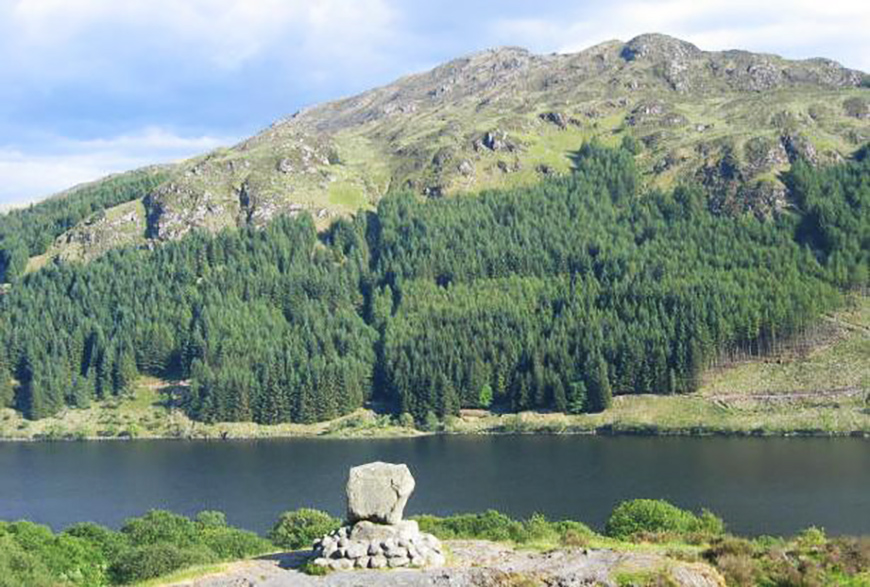
Glen Trool favored Robert, with a loch and a narrow strip of land called the "Steps of Trool" between the loch and a steep slope. Robert positioned men above the narrow passage to loosen granite blocks with levers and crowbars, preparing for attack.
Battle
De Valence sent a raiding party, hoping to surprise Robert. As the English advanced in a single file, Robert signaled his men to push the loosened boulders onto them.
The Scots followed with a volley of arrows and hand-to-hand combat. The English, unable to get support or maneuver in the narrow passage, took heavy losses and retreated.
Aftermath
Though outnumbered, the Scots won a major victory and morale boost. Robert showed adaptability by using the landscape. The First War of Scottish Independence would continue, and he would face de Valence again at the Battle of Loudoun Hill.
In 1929, on the 600th anniversary of Robert the Bruce's death, the Bruce's Stone was placed above Loch Trool, where legend says Robert had commanded the ambush.