Battle of Dalrigh
Background
Following the surprise attack at the Battle of Methven, Robert the Bruce and some of his men escaped and headed westwards towards the mountains of Argyll.
The Clan MacDougall had risen in power in Argyll and backed the Balliol claim to the throne, and after John Comyn was murdered at Greyfriars Church, the Clan MacDougall was opposed to Robert the Bruce. The Clan Macnaghten was influenced by the MacDougalls and formed part of the MacDougall forces that would fight against the Bruce at Dalrigh.
Battle
Robert the Bruce and his army of around 300 to 500, including women, the aged, and a guard of Highland Men, found their path blocked near Tyndrum by a force of MacDougalls, led by John of Argyll, numbering around 1,000 men.
The Bruce could not retreat as Aymer de Valence, who defeated the Bruce's army at Methven, was likely in pursuit of the Bruce and not far behind them to the east. Thus, the Bruce was forced into battle in disadvantageous circumstances against the Clan MacDougall.
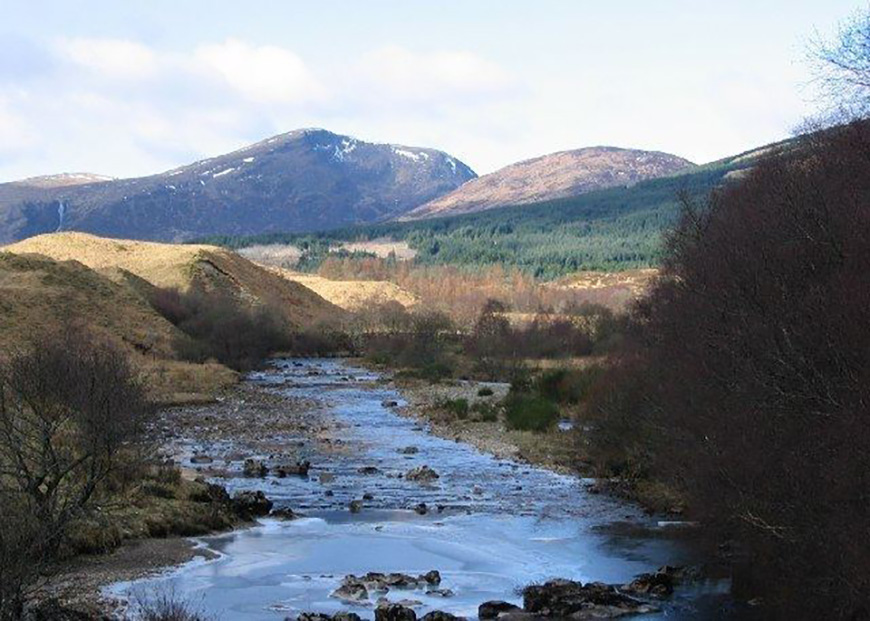
The battle was fought at a place now called Dalrigh, or "The King's Field" in Gaelic. It's not known if the location got its name at the time or was added afterwards by chroniclers.
Tired and outnumbered, the Bruce's forces fought valiantly, but were no match for the MacDougalls. Robert the Bruce was heavily involved in action at the rearguard and at one point found himself alone and under attack between a hill and the loch on a pass so narrow that he could not turn his horse. It is said that one of his attackers tore off the brooch that fastened his cloak, known as the "Brooch of Lorne", which was kept in possession of the Campbells until 1826, when it was given to the MacDougalls. James Douglas was also wounded during the battle.
The Bruce tried hard to disengage and protect his men until they eventually retreated to safety. The Bruce's remaining horses were killed by the MacDougall's axemen.
It was written:
They thereupon withdrew. In this
There was no mark of cowardice.
They kept together; and the king
Was ever busy rescuing
The rearmost of his company.
With skill and valour there wrought he,
And safely all his men withdrew.
He daunted those that would pursue
So none durst leave their cloe array,
For he was never far away.
Aftermath
After the Battle of Dalrigh, Robert the Bruce was little more than a fugitive, pursued by many enemies from Scotland and England. For a time, the Bruce and his men took refuge in the mountains of Atholl. He sent his wife and daughter to the safety of Kildrummy Castle.
Robert the Bruce, James Douglas, and others then moved southwards and crossed over to the Kintyre Peninsula before heading to Ireland.
The battle was a significant setback, with Bruce's army in disarray and no longer fighting as a unified force. He began a guerrilla campaign that would eventually lead to his remarkable recovery and to him becoming one of Scotland's greatest Kings.